My interest in finance started with fairly simple questions. I would see a company’s stock price move and wonder what actually caused it, or look at two companies in the same industry and wonder why investors valued them so differently. The more I came across those questions, the more I realized that I was interested in understanding what was happening underneath the numbers, not just following the numbers themselves.
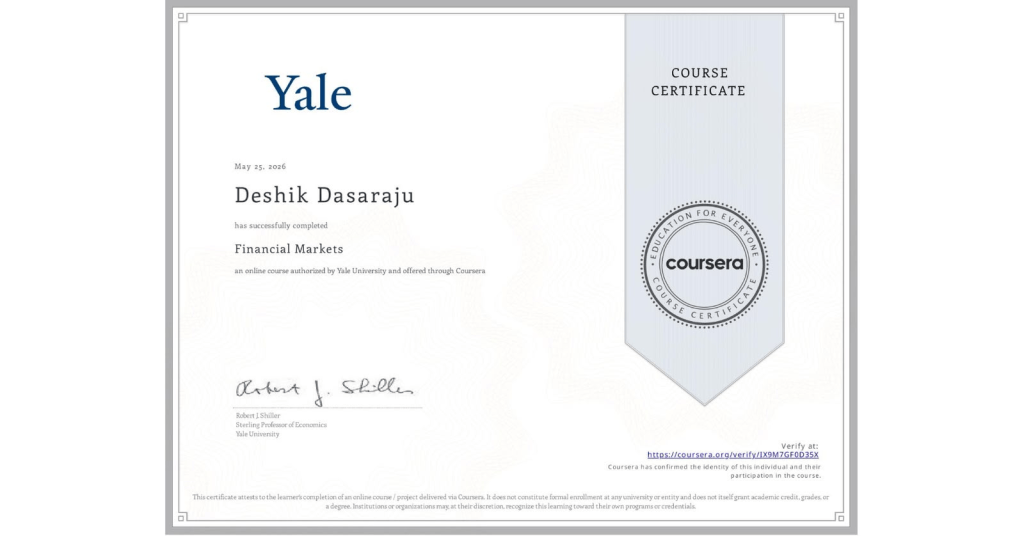
That was what led me to Yale’s Financial Markets course on Coursera. I wanted to learn more about finance outside of school and, more importantly, get a more structured understanding of a subject I had already started exploring on my own. The course, taught by Professor Robert Shiller, covers a wide range of topics including financial markets, risk management, investing, insurance, behavioral finance, banking, and financial regulation.
What I liked about the course was that it gave me a broader picture of how financial markets actually work. Before taking it, my understanding of finance was mostly built around companies, stocks, and investing, but the course helped me see how much more there is to the field. Learning about risk and diversification made me think differently about investing, while the sections on financial institutions and regulation showed me how many different parts of the financial system have to work together.
I also found the behavioral side of finance especially interesting. Markets are made up of people, and people do not always make decisions based purely on logic or numbers. The way investors react to uncertainty, information, and risk can influence markets just as much as the financial information itself. That made finance feel much less like a subject that was only about calculations and much more connected to psychology, decision-making, and real-world behavior.
Another thing I valued was simply having to learn the material independently. There was no teacher in my classroom reminding me to keep up with the course, so staying consistent was my responsibility. That sounds small, but for me it was part of the value of taking it. I was studying something because I wanted to understand it, not because it was part of a school assignment, and that made it easier to stay interested when the material became more technical.
By the time I finished the course, I had a better foundation in finance and a much clearer idea of what I want to explore further. I still have a lot to learn, but that is actually what I found most valuable about the experience. The course did not make me feel like I had learned everything about financial markets; it gave me enough of a foundation to understand the questions I was asking and enough curiosity to keep looking for better answers.
Completing the course was a good step for me because it connected something I was already interested in with a more structured academic experience. It also gave me a better idea of what studying finance in college could look like, and confirmed that this is a subject I want to continue exploring.
That’s really why I took the course in the first place. I wanted to see whether my interest in finance would stay interesting once I moved beyond simply reading about companies and markets on my own, and after completing Yale’s Financial Markets course, I know that it does.
 Deshik Dasaraju
Leave a comment